American Express
Membership Rewards
Modernizing points redemption, history and reversal journeys for global Customer Care Professionals.
01
Background
The product
The Intuitive Servicing Portal (ISP) is an internal platform used by American Express Customer Care Professionals (CCPs) worldwide to support Card Members. ISP centralizes core servicing workflows such as Credit & Fraud, Membership Rewards, Capabilities & Servicing, Account Maintenance and many more.
This case study highlights some key journeys specifically within Membership Rewards. For the wider platform story, see the Intuitive Servicing Portal case study.
02
The ask & my role
The ask: Modernize the Membership Rewards redemption, history, and reversal flows by replacing the multi-step Pega legacy system with a cohesive, efficient experience.
User Research Lead
Conducted user interviews and usability tests, mapped the user journey, gathered feedback and synthesized data into design solutions.
UX Designer
Facilitated workshops with project managers and stakeholders, provided sketches and wireframes, and incorporated research findings into high-fidelity prototypes.
03
My process
Every project follows the same backbone, flexed to fit the timeline and the questions we need answered.
- Project introduction. My first step with any project is to understand the current experience and conduct a heuristic analysis.
- Define objectives. Frame hypotheses, success metrics and constraints; draft problem statements and key jobs-to-be-done.
- Research strategy. Select methods (e.g. interviews, usability tests, surveys, A/B testing), recruit target users, and plan the study.
- Data synthesis. Affinity-map findings, surface themes and pain points, craft personas and prioritize by impact and effort.
- Testing & prototyping. Iterate from low- to mid- and hi-fi wireframes; run rapid usability tests to validate flows, IA and copy.
- Next steps & future planning. Roadmap features, scope the MVP and subsequent releases, track KPIs and outline ongoing research and optimization.
04
Research strategy
Objective
Evaluate how Customer Care Professionals currently use Membership Rewards, mapping the redemption, history and reversal journeys to surface pain points, redundancies, step-outs to external tools and outdated procedures that hinder efficiency.
Methods & why
I believe the best way to uncover these insights is through user interviews and usability testing.
User interviews
Capture CCPs’ workflows, mental models, policy constraints and workarounds across redemption, history and reversal.
Usability testing
Observe real task execution to quantify friction, errors, time-on-task and external step-outs, and reveal redundancies and outdated procedures.
Together, they triangulate intent and behavior to prioritize high-impact fixes.
05
Interview do’s & don’ts
Simple guidelines I use to maximize the effectiveness of user interviews and interview guides.
Listen & learn
DoLet silence work; give participants time to think and expand on their responses.
Be curious
DoAsk open, non-leading questions; probe with “why” and “tell me more.”
Make assumptions
Don’tDon’t rely only on self-report; ask for concrete examples.
Set goals
DoSet clear objectives and write a focused discussion guide.
Be biased
Don’tDon’t pitch solutions or defend the product. Stay neutral and open.
Get permission
DoObtain consent; explain purpose, recording, and confidentiality.
06
Interview guide
The Membership Rewards Audit guide set the objective, logistics, session structure and task-based usability prompts for each 45–60 minute remote session.
07
User insights
Affinity mapping surfaced a clear theme: CCPs were spending their attention on the tool instead of the Card Member. A few of the voices behind it:
“Every time I need a policy or disclosure I have to leave ISP and hunt through CHC. New reps get lost finding the right article and calls drag on while we search.”
“Why am I re-entering the member’s DOB on three screens? It’s already in the profile!”
“If one thing changed it would be auto-populated fields and an at-a-glance view with everything I need. Removing redundant screens would let me focus on the member instead of button clicks.”
“If ISP showed card type and tenure up front, I could personalize offers immediately.”
“New hires ask me where to find disclosures every day. We need it built into the flow.”
“Having to jump to CHC mid-call breaks the rapport. Members hear silence while I hunt.”
08
User flows
Mapping the current-state flows made the redundant steps, manual hand-offs and step-outs to the Customer Help Center (CHC) impossible to miss.
09
Problem statements & insights
- Limited visibility into Card Members’ points and account details. Customer care professionals cannot view “Points Pending” and must hunt across disparate fields to find account status, membership type and other essential details. This data gap creates a disconnect between CCPs and Card Members, increases call handling time, forces workarounds, and raises the risk of errors and frustrated members.
- Frequent step-outs to a third-party knowledge base interrupt workflows. Critical procedures, guidelines and disclosures for Membership Rewards live in a separate Customer Help Center (CHC). CCPs routinely leave ISP to locate the correct CHC article, which lengthens calls, increases cognitive load and leads to inconsistent service, especially for newer CCPs who struggle to identify the right guidance.
- Legacy PEGA flows introduce redundant steps, rework and error risk. Membership Rewards journeys are implemented in an outdated PEGA system that requires repeated data entry, redundant screens and obsolete procedures. These inefficiencies slow task completion, increase error rates and cycle time, and prevent ISP from delivering a streamlined, auditable servicing experience.
10
Design goals
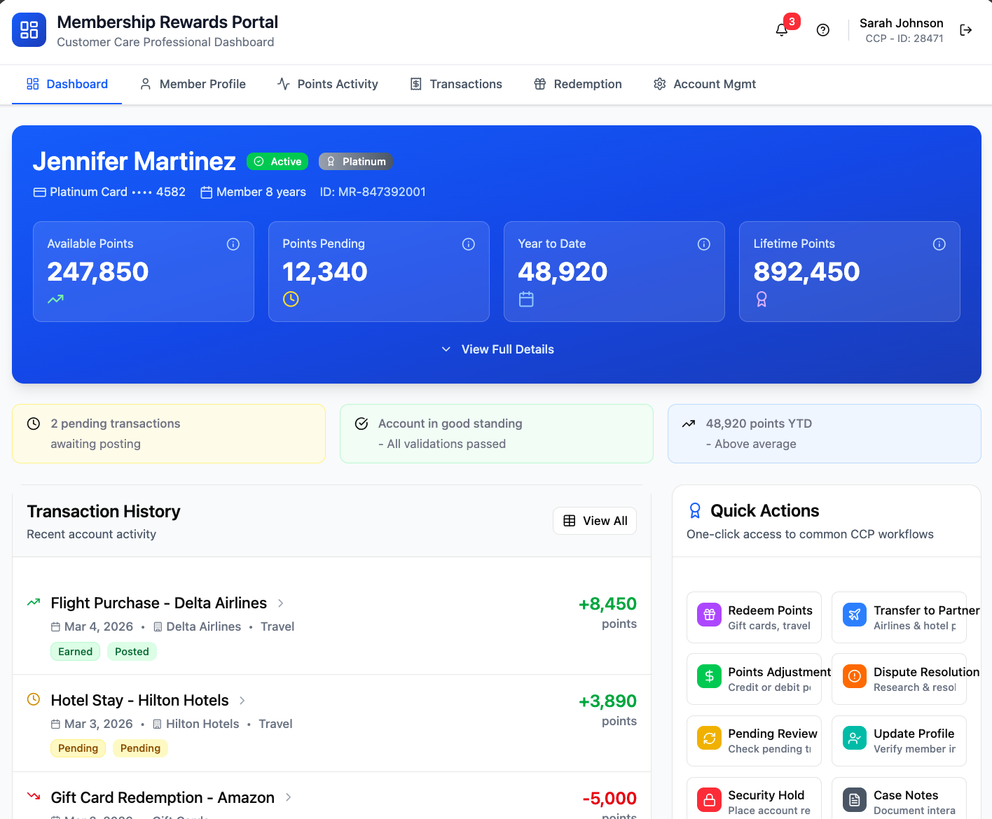
Bridge the data gap by adding a glanceable MR header/dashboard that shows Available Points, Points Pending (timestamped), account status, card type and tenure. Showing real-time values or indicators reduces unnecessary escalations and speeds time-to-first-action so CCPs can lead conversations confidently.
Offer embedded CHC snippets, disclosure templates and one-click quick links as expand/collapse panels tied to task and role so CCPs don’t step out. Task-specific defaults and relevance ranking standardize responses and cut training friction.
Streamline flows to remove redundancies by consolidating screens, auto-populating verified profile fields, centralizing decision logic and adding inline validations. Removing repeated entry and retiring obsolete steps with Compliance yields faster task completion, fewer errors and lower training overhead.
11
Figma Make AI exploration
Due to proprietary restrictions I can’t share the original American Express screens or assets. Instead, I synthesized the project scope, research artifacts, journey maps and findings into a research-driven prototype generated with Figma Make.
This prototype, my first with this AI tooling, was seeded with my interviews, pain points, design objectives and governance requirements to produce a high-fidelity, interaction-focused prototype that embodies the recommended MR dashboard, inline policy surfaces and streamlined flows, pictured at the top of this page: points at a glance, pending points, transaction history and quick actions in one view.
This approach preserved confidentiality while showing how research insights translate into tangible UX solutions, and how complex systems work can be distilled into actionable, testable designs that align with enterprise governance and accelerate stakeholder buy-in.
12
Final reflections & next steps
This engagement reinforced that targeted visibility, contextual guidance and process consolidation drive the biggest operational gains for CCPs, not cosmetic changes.
Moving forward, I recommend validating the Figma Make prototype with moderated usability sessions and an in-platform pilot with a small CCP cohort to measure average handle time, step-outs, error rates and first-contact resolution.
Parallel workstreams should formalize compliance sign-off, implement the AMEX component library, and instrument telemetry for post-launch monitoring and iterative optimization. Ultimately, the aim is a phased rollout that de-risks change, proves ROI, and creates a repeatable pattern for modernizing other legacy servicing journeys.